Organizations with recurring vendor contracts usually have someone who negotiated them, someone who approves the invoices, and someone who manages the vendors day to day. In many organizations, it is less clear who keeps those responsibilities aligned once the relationship is underway. That's the governance gap, and it's the reason vendor governance exists as a discipline separate from procurement, accounting, and operations — even though it touches all three.
What SGG does
SGG performs contract-to-invoice reconciliation and organization-wide pattern review for recurring service categories — pest control, landscaping, janitorial, waste removal, HVAC maintenance, elevator and life-safety systems, and similar contracts that renew quietly and bill monthly. The function is document-based: contracts, invoices, amendments, renewal notices, and approvals go in; a governance record documenting alignment, drift, and open questions comes out.
It is not vendor management, and it is not a renegotiation. No vendor is contacted. Nothing in day-to-day operations changes. SGG works alongside procurement, accounting, and operations — it doesn't replace any of them — and hands leadership a record they can act on.
The gap that opens after signature
Before a contract is signed, scope gets defined, pricing gets negotiated, terms get reviewed, and approval gets documented — usually by identifiable people, on a clear timeline. After signature, the relationship goes operational: rates change, services evolve, add-ons accumulate, renewals occur, and the paper trail behind each of those events becomes someone's side task instead of anyone's whole job.
None of this happens through negligence. It happens because recurring service contracts are individually small enough that no single invoice looks worth a formal review — until you place a year of them side by side. And the drift isn't always the vendor's doing — sometimes the organization itself has changed (a location added or closed, an acquisition, a shift in regional footprint) while the vendor arrangement quietly stayed the same. See How SGG Creates Value for how that second kind of change gets governed.
Why no single function owns it
Procurement
Leads the competitive process and negotiates pricing, but typically exits once the agreement is executed. The relationship becomes someone else's.
Operations
Knows whether the vendor shows up and does the work, but isn't positioned to maintain the complete contractual record behind that work.
Accounting
Verifies coding, approvals, and math on each invoice. The separate question is whether years of amendments and rate changes still match the governing record.
Finance
Sees aggregate spend movement, but a budget variance alone doesn't explain whether it came from escalation, new scope, add-ons, or a documentation gap.
Each function may be doing its job correctly. What's missing is the layer that sits across all four on a defined recurring cadence—comparing what was signed with what the available billing, approval and supporting records show, regardless of who currently holds any of those seats. That's the role a governance review fills. It's a pattern SGG sometimes shorthands as "nobody owns this"—not a criticism of any one team, but a description of how the responsibility gets divided.
Think of organizational attention as three layers — rocks, pebbles, and sand. This is the layer where SGG operates.
 Click to enlarge
Rocks
Big strategic priorities — the initiatives that get board-level attention because they're too large to miss.
Pebbles
Recurring vendor-governance decisions. Individually too small to justify a formal review on their own — but unlike rocks, nobody's job is to watch them accumulate.
Sand
Day-to-day operations — the volume of small tasks that gets handled as a matter of course, precisely because it's visible and routine.
Contract-to-invoice reconciliation
This is the mechanical core of the work: does the invoice match what the contract actually specifies, line by line, month by month? At a single location this sounds simple. Across an organization with dozens of vendors and hundreds of recurring line items, it rarely happens as a complete, current exercise — because no one's job is to pull every contract and every invoice together on a fixed schedule and check.
SGG builds a source-linked ledger for the vendor relationships under review: one row per billed line item, connected back to its invoice and its governing document. That structure is what makes invoice audit and contract compliance checking repeatable instead of a one-time forensic exercise.
Vendor price escalation
Many recurring contracts include some escalation mechanism—a CPI clause, a flat annual percentage, a fuel or administrative surcharge. These exist for legitimate reasons. The governance question isn't whether an escalator is fair; it's whether it was applied the way the contract specifies, with a reviewable approval trail, and consistently across the locations included in the review.
What this looks like in practice
A contract includes a 3% annual CPI escalator. Across an operating footprint of comparable locations, the same clause activates at 3% in some cases, 4.5% in others, and not at all in a few — with no invoice flagging the difference. The variance is only visible once billing is compared line by line against the agreement and its approved changes, location by location.
Read the full breakdown in Vendor Price Escalators.
Scope and service drift
Contracts specify a scope — frequency, coverage, service level. Over time, actual service can quietly diverge from that scope in either direction: a reduction that never gets formalized, or work that expands past what was ever priced or amended. Billing usually stays flat through both. Scope drift is rarely adversarial — it happens because a change gets agreed informally, in a walkthrough or a phone call, and the paperwork never catches up.
Related reading: Contract Drift.
Documentation and authorization gaps
Not every rate on an invoice traces back to a signed document. A verbal confirmation during a budget cycle, an email approving "the new number," a scope letter with no formal contract behind it — these are common, and not automatically a problem. The issue is what happens when someone later needs to reconstruct why a rate is what it is, and the answer only exists in someone's memory.
A decision can be entirely valid and still leave a weak record. See Documentation vs. Approval.
Cross-location inconsistencies
A rate or a scope that looks reasonable at one location can look very different placed next to the same vendor category at nine other locations, or the same service category across markets. Cross-location vendor oversight is what makes that comparison possible — and it's a comparison that almost never happens organically, because looking across the whole organization at once isn't any single role's job.
This is often where the most actionable findings surface: not one vendor doing something wrong, but a pattern — one market paying materially more than another for a functionally identical service. More in Why Cross-Location Comparisons Matter.
Recurring-service vendor oversight
The categories that renew quietly and bill monthly accumulate drift the fastest, precisely because each individual invoice looks too small to justify scrutiny on its own: pest control, landscaping and grounds, janitorial and common-area services, waste and recycling, HVAC preventive maintenance, elevator maintenance, fire and life-safety systems, snow removal, and security and access control. Recurring-service vendor expenses in these categories are frequently the largest cumulative, least-monitored line items an organization carries — which makes them exactly the categories a governance function should be watching on a recurring cadence, not a one-time basis. See Recurring Governance Reporting.
Examples of the kinds of issues SGG identifies
- Undocumented rate increases — billing that moved from the contracted rate with no amendment, notice, or written authorization on file.
- Inconsistent escalator application — the same clause applied at different rates or timelines across comparable locations.
- Unformalized scope changes — service frequency or coverage that has shifted from what the contract specifies, with billing unchanged.
- Missing or unsigned governing documents — active relationships with no fully executed contract, or a contract that has technically lapsed while billing continues.
- Renewal exposure — auto-renewal terms and notice windows approaching without enough lead time to renegotiate or exit.
- Cross-location rate disparities — the same vendor or category priced meaningfully differently across markets with no explanation on file.
- Invoice anomalies — arithmetic inconsistencies, duplicate charges, or unit-specific work billed outside the recurring schedule without documentation.
These are recorded as observations, not findings of wrongdoing. Most of what surfaces reflects ordinary erosion of continuity over time — not bad faith on anyone's part. See how this distinction plays out in Auditing vs. Governance.
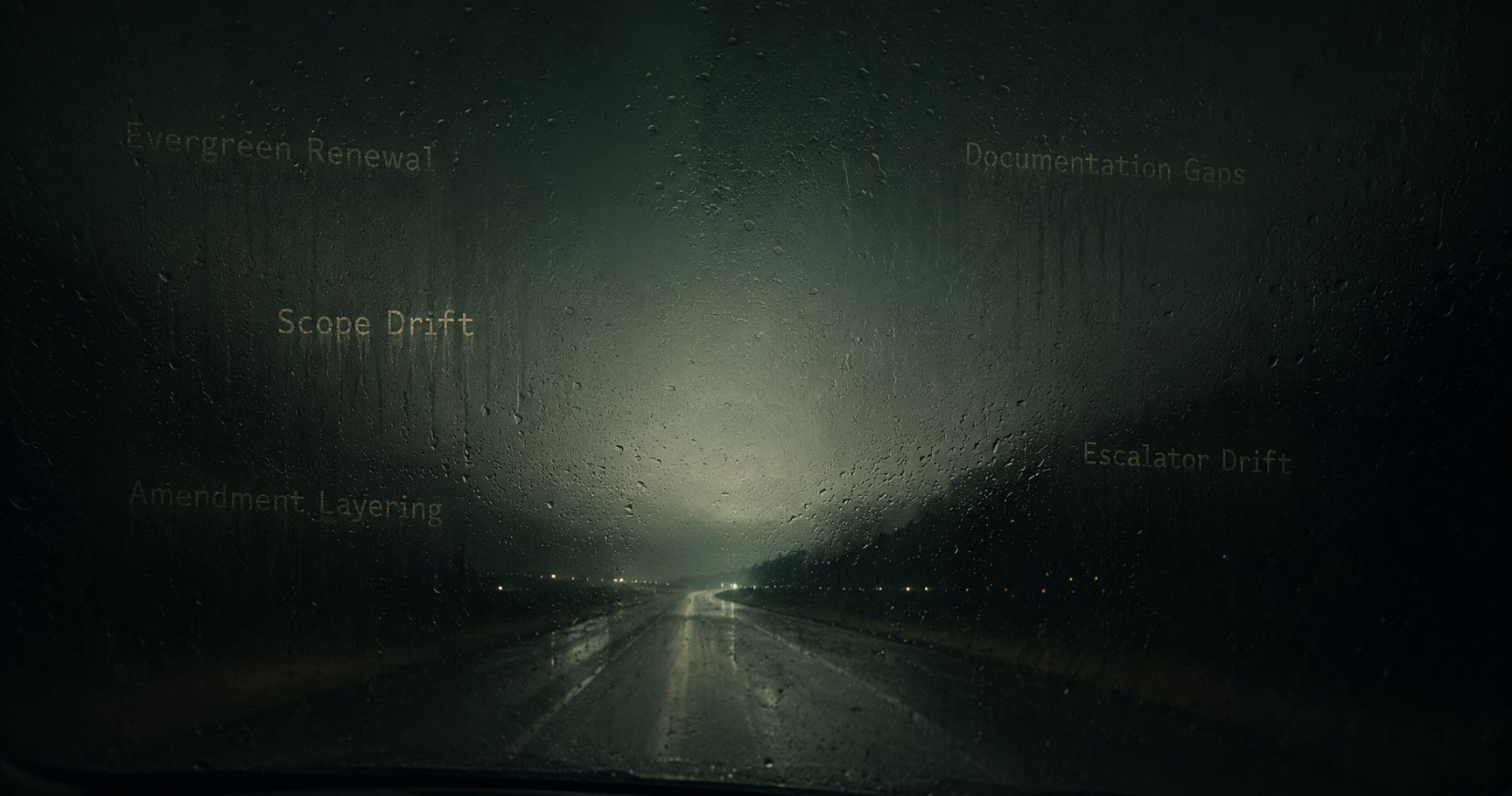
Individually, each of these looks minor. Viewed together over time, they fog the view.
 Click to enlarge
What management receives
The output is a written governance record organized around the questions a future reviewer would actually need answered: what does the contract say, what is currently being billed, what has changed, and what needs a decision. The full breakdown of deliverables — executive summary, source-linked ledger, exception register, cross-location comparisons, open-item list, and governance recommendations — is covered in detail on the How It Works page.
What to do with any given observation stays entirely the organization's call. The review's job is to make sure the question can be answered accurately when it comes up — not to make that call for them.
Why this work falls between departments
Post-contract vendor governance isn't a gap because any one team is doing something wrong. It's a gap because facilities vendor management, procurement, accounting, and operations each own a piece of the relationship, and none of them owns the connective layer that verifies the whole thing stays aligned over years, across renewals, and across staff turnover. That connective layer is what SGG provides.
Everything above describes the reconciliation work for one property, facility, or site. Where an organization has more than one, the same discipline extends into comparing vendors and pricing across all of them — see How SGG Creates Value.
See where your own organization stands.
SGG reviews contracts, invoices, amendments and recurring service patterns across the organization — starting with a single service category.
Request a Governance Review